What were the big ideas?
The main ideas presented in week two’s lecture related to the skill of addition. This lecture also extends on the definition of mathematics by further emphasizing the importance of ‘recognising, exploring, extending, representing, and understanding patterns and relationships’ to help students recognise and use this language more frequently during their time in school.
My understanding of the weekly topic has changed as I now understand the importance of demonstrating breaking down sums to portray more than a symbol and by doing this students can gain a better understanding and conceptualisation of these mathematical ideas through the use of more appropriate language and creative resources.
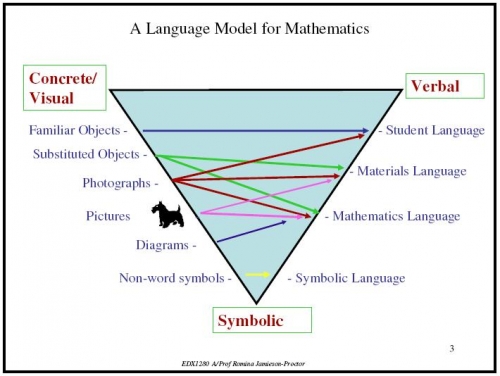
The previously listed understandings will shape my future teaching abilities as I will teach the concepts, skills and strategies involving Addition by utilising The Language Model, to more efficiently move students through the four stages from concrete and verbal, to eventually symbolic being the final goal. Keeping in mind that all children learn at different rates.
Addition: concept, skill or strategy
The Addition concept can be simplified and explained as the joining of groups together to find a total. This concept is usually first introduced in the foundation to year 1 of schooling. Just like most other mathematical concepts when teaching addition the language model containing 4 stages needs to be taken into consideration . Students must PHYSICALLY move things together to develop the understanding in their head (Jamieson-Proctor & Larkin, 2012).
Misconceptions
One of the main misconceptions relating to Addition is the thought that when numbers are added together that the final answer is always larger however, this is not the case. As students in primary school progress to solving higher levels mathematical equations that involve addition this thought may lead to confusion. When dealing with negative numbers, the answer is not always larger.
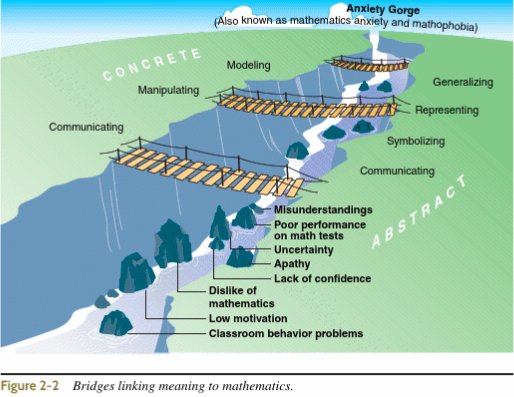
To avoid students developing this misconception during lessons I would focus more on teaching for understanding and allow students to gain deeper conceptualisation, by including more creative activities when dealing with problem-solving.
ACARA
Addition within mathematics is first introduced within the Australian Curriculum in the foundation year. (ACARA, v8.3).
Mathematics/ Foundation Year/ Number and Algebra/ Number and place value/ ACMNA004

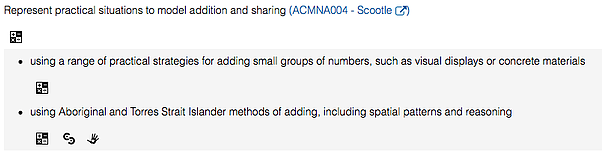
Scootle Resource
Addition and subtraction level 1: numbers to 5 is a registered Scootle resource/activity that can easily be used for young children ranging from the foundation year to grade 2. Students are required to read simple word problems and find the tile matching the answer description or total it equals to. For example, two groups that make 4 together?. This particular activity provides an engaging opportunity for students to explore and realise how useful it is to solve addition problems. It also clearly communicates the connection between worded problems, symbols and simple equations.
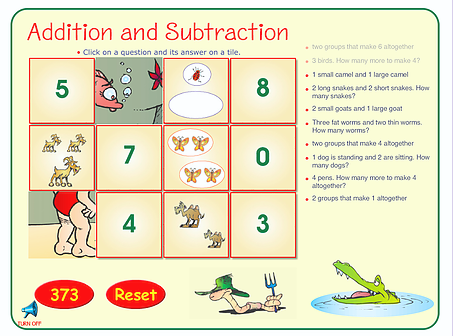
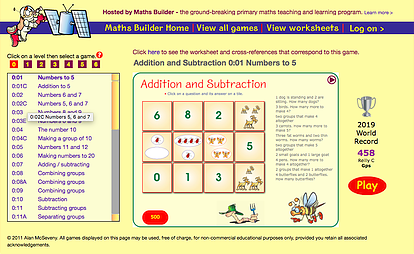
Screenshots of the game all retireved from https://worksheets.mathsbuilder.com.au/games/selector/Addition_and_Subtraction/0/
This resource would be appropriate to use at the mathematical language stage as it uses a good combination of visual graphics and word problems.
Resources or Teaching Strategies
This is an addition mat. It is used to demonstrate the concept of addition in early primary classrooms. I am intrigued by the use of these clever addition mats when teaching lesson in early mathematical concepts. This resource allows children to see physical representations of numbers and how they can be brought together to cretae a total, while assisting in the strategy of counting on. This resource would also be an engaging way to personalise the lerning for some children with additional needs as it be changed to suit different interests. e.g. an autistic child with a very strong interest in planes.
Textbook: Concept, skill or strategy
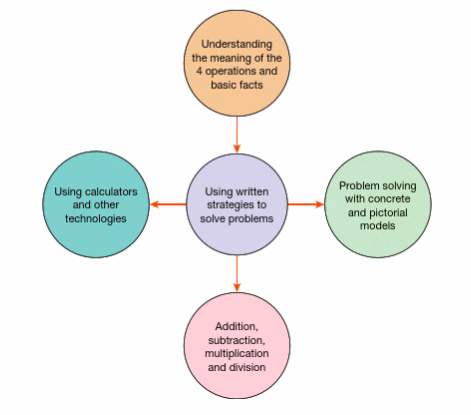
In chapter 11, Reys discusses the evolution of teaching strategies and older methods for teaching mathematical equations such as using paper-and-pencil procedures (or computational algorithms ) and how they were once considered an essential component for teaching. However, he then proceeds to explain that this has since been outdated and through research new methods have been discovered and implemented in many classrooms. The focus has shifted to what the students themselves construct or develop through making meaningful connections. Students are now encouraged to share their way towards solutions, justify their thinking and communicate their findings. The tradition of once having to memorise procedures given by the teacher or mentor, without concrete understanding is not the preferred approach (Reys, 2014).
References
Education Services Australia. (2019). Scootle. Retrieved May 7, 2019, from http://www.scootle.edu.au/ec/p/home
Jamieson-Proctor, R., & Larkin, K. (2012). “Mathematics as a Language”: A Theoretical Framework for Scaffolding Students’ Mathematical Understanding. Retrieved from https://leo.acu.edu.au/pluginfile.php/3070058/mod_book/chapter/189986/Maths%20Language%20Model.pdf
Maths Builder. (2011). On Your Mark Mathematics. Retrieved from https://worksheets.mathsbuilder.com.au/games/selector/Addition_and_Subtraction/0/
Mikkelsen, P. (2013, May 8). Addition Mat [Video file]. Retrieved from https://youtu.be/H9knavDn5lQ
Reys, R. E. (2014). Helping children learn mathematics 2e. Retrieved from https://ebookcentral-proquest-com.ezproxy2.acu.edu.au
 Weekly Reflections