What were the big ideas?
Following on from last week the big ideas of week 10 involve the teaching of Algebra and providing students with multiple opportunities to use this concept when problems solving. Students are more able to easily understand the concept of algebra when they have a good knowledge of the general number properties. Example of these include their additive identity or commutativity (Assessment Resource Banks, 2019).
Many of the concepts related to algebra are best taught at a younger age because common misconceptions which may develop can inhibit a student’s ability to work with the related symbols later on.
Algebra: one concept, skill or strategy
In pre algebra, students are often found to struggle with equation solving. In order to provide students with the available the skills and tools that are required for manipulating given equations, students are to be exposed to the suitable algebraic language, notations and reasoning (Van Amerom, 2003).
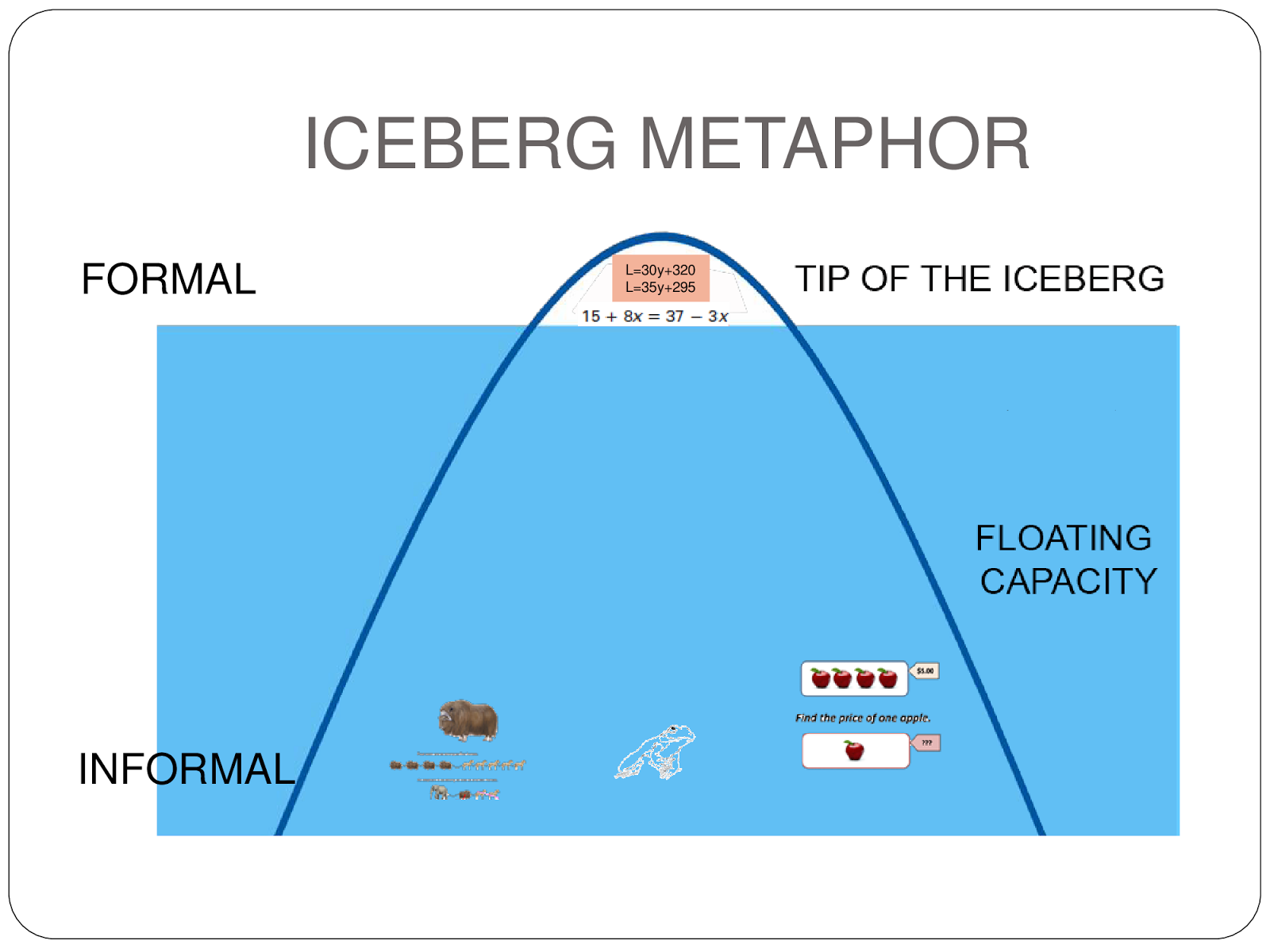
For instance, older students in grades 6 and 7 are physically able to solve equations at both a formal and an informal level, but when it comes to communicating and providing their reasoning formal symbols thats when tasks become a major obstacle.
Misconceptions
All learners are not blank slates. Each student at the start of a new year brings prior knowledge into a lesson, and that knowledge whether possitive or negative is proven to influence what the student will gain from the experience.
In relation to algebraic problem solving, one main type of prior knowledge that is essential to learning is the conceptual understanding of features involved in the problem. Examples of these include features such as different variables, common or “like” terms and negative signs. Having a conceptual knowledge of these features is not just the ability to recognise these symbols or successfully use them in an operation, but understand why the feature is there an what its purpose is, students should be able to ask themselves “will changing the location of the feature affect the overall problem?” (Booth & Koedinger, n.d). Overall, lack of understanding about these various features will consequently interfere with a students performance when solving equations that involve a specific procedure.
Resources or teaching strategies
All screenshots of the resource retrieved from:
https://www.splashmath.com/algebra-games
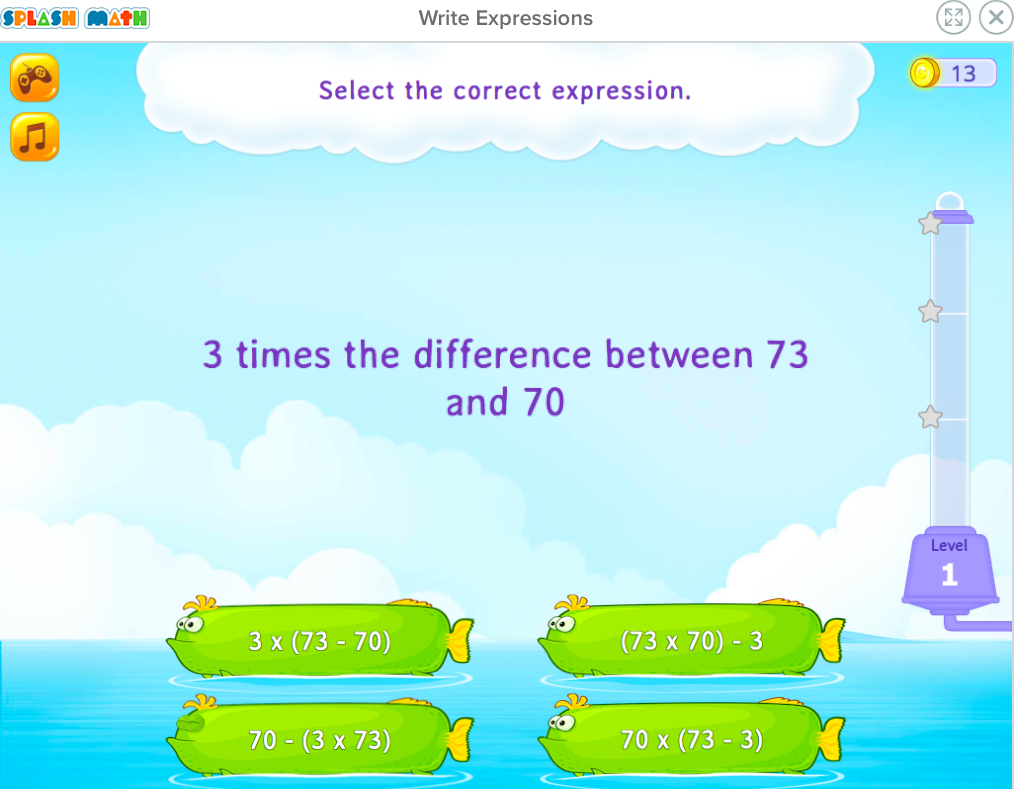
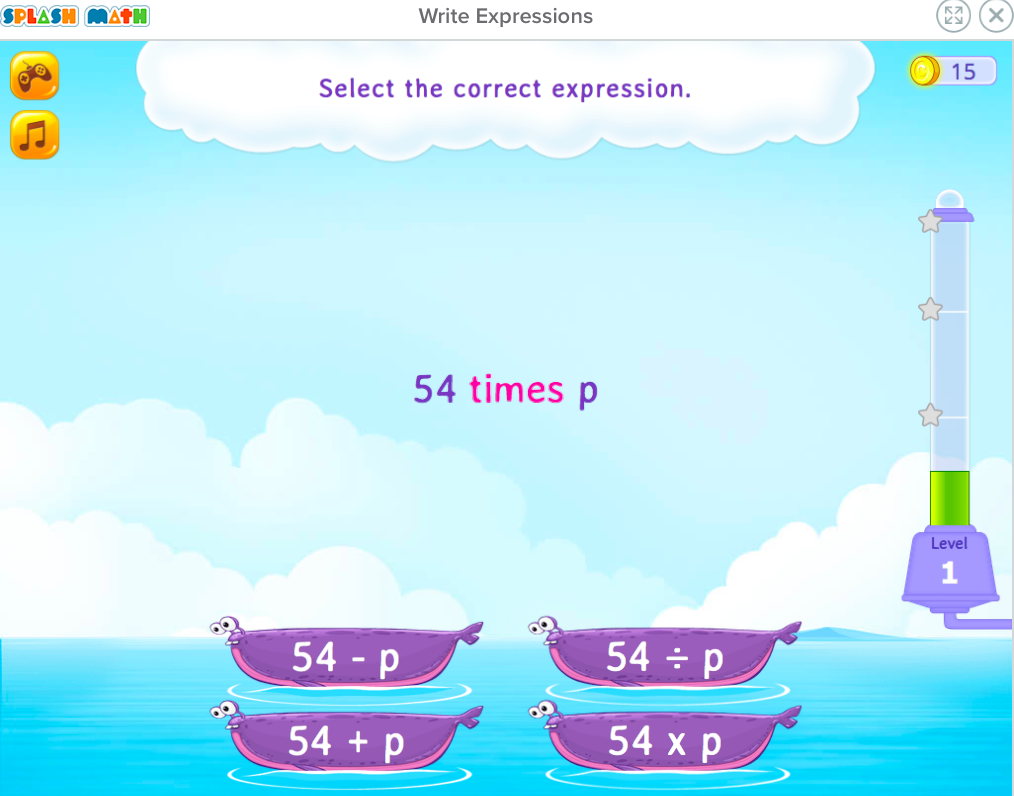
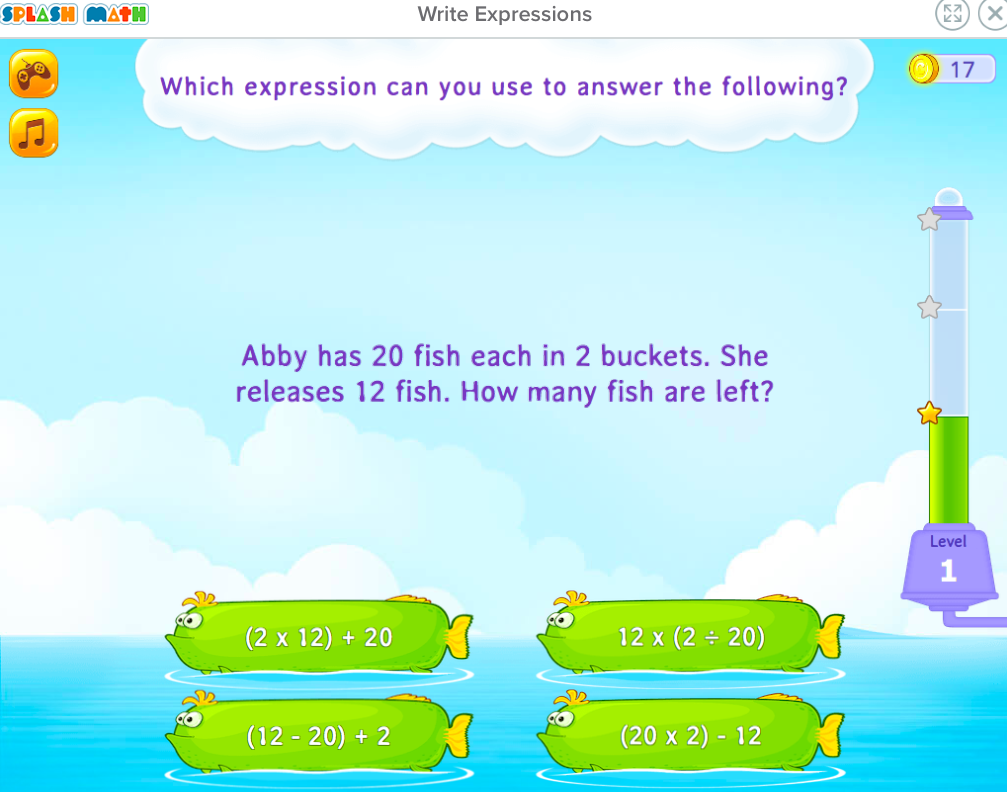
Write Expressions is a resource that aims to help students recognise and write algebratic expressions. This resource is particularly aimed at older students in years 5 and 6, as it revisits problem solving skills in order to solve given scenarios. This resource would be introduced to students who are at the symbolic stage of the Algebra language model, as they are already using and understanding the language of repeating, and growing patterns and are able to then expand their knowledge in a more formal and structured way (Splash Math, 2019).
Textbook : concept, skill or strategy
Many primary mathematics curricula include the use of equations to solve routine problems but what they dont know is they fail to emphasis helping students realise where these equations come from and how they make mathematical sense (Reys, 2014). Reys chapter 15 describes how non-routine algebratic problems can be easily represented to students through picturea and other modelling methods. By utilising these non-routine algebratic problems teachers can provide students with various opportunities to perform the skill of analysing number patterns and continuing the pattern (Reys, 2014).
References
Assessment Resource Banks. (2019). Algebraic thinking concept map. Retrieved from https://arbs.nzcer.org.nz/algebraic-thinking-concept-map#introduction
Booth, J., & Koedinger, K. (n.d.). Key Misconceptions in Algebraic Problem Solving. Retrieved from https://pdfs.semanticscholar.org/ebcd/e07919d049b73d44702c549b8c1aa71683e5.pdf
Math Antics. (2015, May 22). Algebra Basics: What Is Algebra? – Math Antics [Video file]. Retrieved from https://youtu.be/NybHckSEQBI
Reys, R. E. (2014). Helping children learn mathematics 2e. Retrieved from https://ebookcentral-proquest-com.ezproxy2.acu.edu.au
Splash Math. (2019). Algebra Games for Kids Online. Retrieved from https://www.splashmath.com/algebra-games
Van Amerom, B. A. (2003). Focusing on informal strategies when linking arithmetic to early algebra. Educational Studies in Mathematics, 54(1), 63-75. doi:10.1023/b:educ.0000005237.72281.bf

 Weekly Reflections