What were the big ideas?
The big ideas included in the lecutre of week 6 involved looking at pre-number concepts. After this week I now understand how patterning connects all of these pre-number concepts together. During this week it was also discussed how pre-number principles are prerequisite skills for being able to perform all the stages of the counting principles to an adequate standard. Because of these discussions I am now able to visualise the relationships between all three types of numbers and the counting principles, as some things can be counted and others cannot-therefore students need to understand when to apply this recent knowledge.
My understanding of this weekly topic has definitely changed as I have learnt the importance of students being able to develop pictures in their heads to recognise patterns immediately. In the future during lessons I will be able to recognise if students can understand all five counting principles, and if they are struggling to grasp these concepts how I can adjust their learning by using the other big ideas.
Multiplication: One concept, skill or strategy
The concept of patterning links all the pre-number mathematics concepts together, as it requires skills such as determining, matching, sorting, comparing and ordering. patterning is the repeating of sets, these representations can vary from visual, auditory or through patterns that incorporate movement. Patterning encourages children to use all of their senses to organise and remember mathematical ideas and relationships making it an important concept to learn early. Using patterns in the classroom can be a fun and engaging way to teach problem solving. To completely understand the concept of patterning successfully, children must demonstrate these various skills:
- Construct patterns
- Directly Copy patterns
- Create their own personal patterns
- Extend already exsisting patterns
Overall, as a pre-number concept children are exposed to patterning very young, and can pick up patterns before they are even taught the concept at school. In oder for a student to do well in later mathematics such as algebra and geometry they must understanding the importance of patterning as a prerequisite.
Misconceptions
A common misconception that children may develop when learning to perform the skill of patterning if taught incorrectly is when they see a pattern and don’t understand that patterns are repeating ‘sets’.
Patterning is very important because it requires a skill to organise and remember relationships. If a student does struggle to recognise patterning as repeated sets, they may miss and become unable to visualise the relationship between the sets as they keep repeating. Something that could affect this is if the student cannot perform determining, matching, sorting, comparing or ordering skills from the earlier pre-number concepts. If a child must first recognise the sets of patterns they are give or they will not be able to build upon it , extend it or insert missing links.
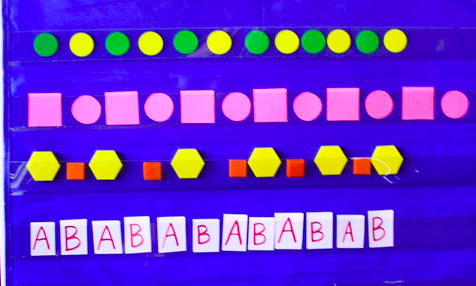
In the future to avoid this misconception I would allow more time for the students to revise their skills to make sure they can all determine, match, sort, compare and order to a satisfactory level. To complete this I would use familliar materials and vocabulary associated with the the children’s language stage, For example words such as ‘describe’ and ‘match’. Only when students can perform these tasks will I re-introduce patterning followed by an explanation about how patterns are sets. Using demonstrations with coloured blocks would also enhance the explanation and allowing student to visualise the relationships.
ACARA
Sorting is first introduced to students in the Foundation year within The Australian Curriculum Assessment and Reporting Authority (ACARA, 2017). However, technically it was first introduced during the early childhood education years (0-5) because sorting is considered a natural skill that children instincively develop.
Mathematics/Foundation Year/ Number and Algebra/ Patterns and algebra/ ACMNA005

Scootle Resource
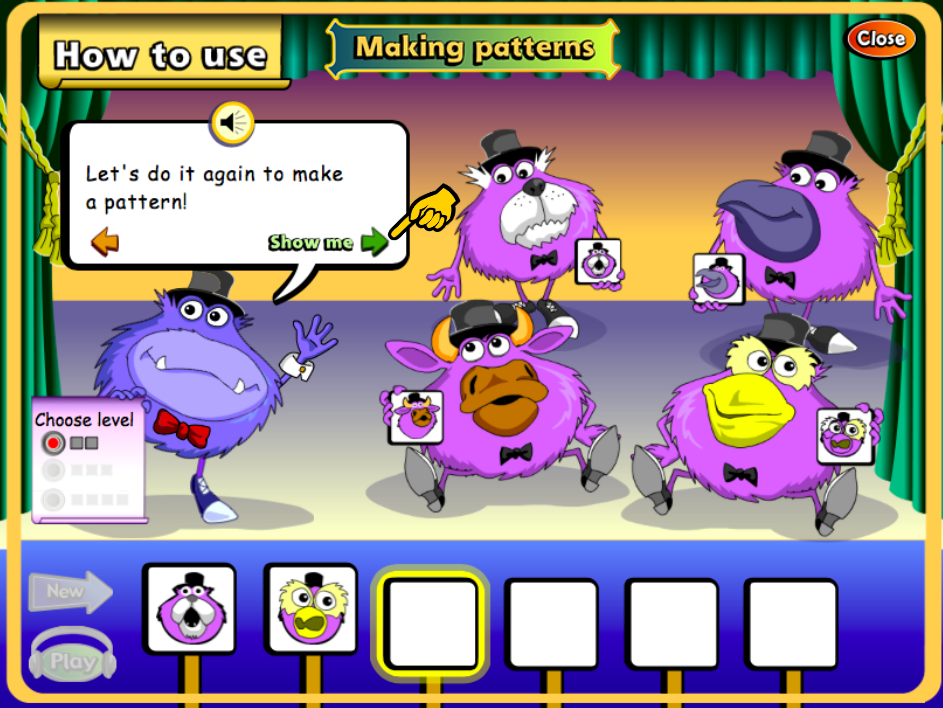
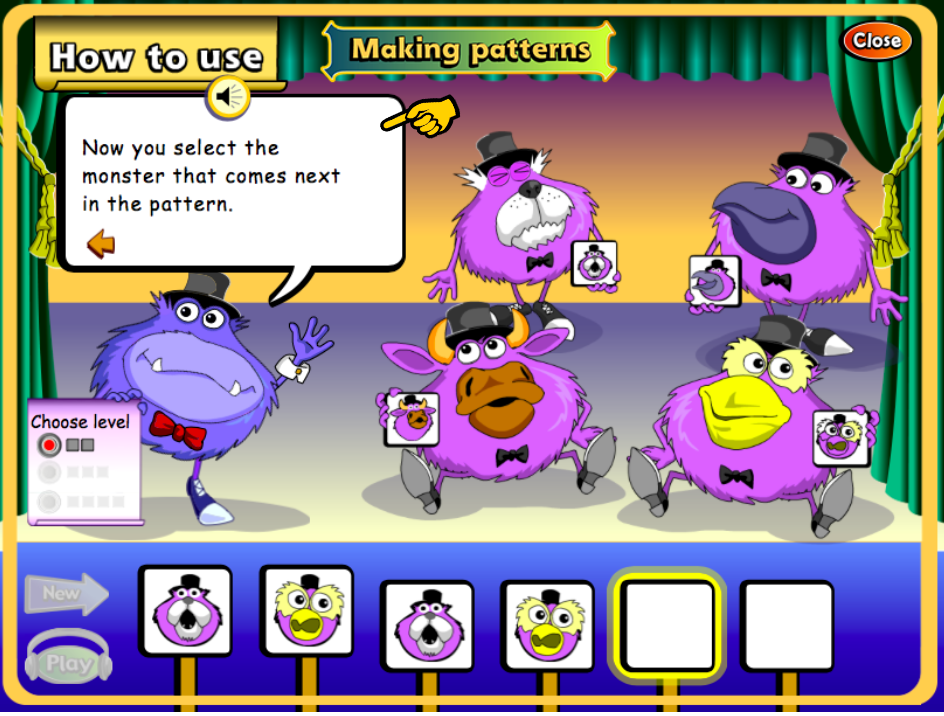
Monster Choir: Making Patterns is a Scootle resource that is recommended for children from the Foundation year into grade 2. Students are simply required to help a group of monsters in a choir to make specific animal sounds in order. Students are able to make a sequence of up to four sounds. By choosing the correct monsters will mean their sounds match the sequence. Repeating the pattern will make a song (Education Service Australia, 2016).
This game is a good resource and would be used when children are at the mathematical language stage because it uses language like “match” and doesn’t include symbols. Students who are in the foundation year would find this enjoyable, but may become difficult if they are unable read, as the game only uses voice commands and instructions at the very start of the game. However, the game is easy to figure out and also allows children who find it easy to test themselves and adjust the difficulty level. Overall this is a good example of a resource that will successfully encourage sorting and matching skills.
Resources or Teaching strategies
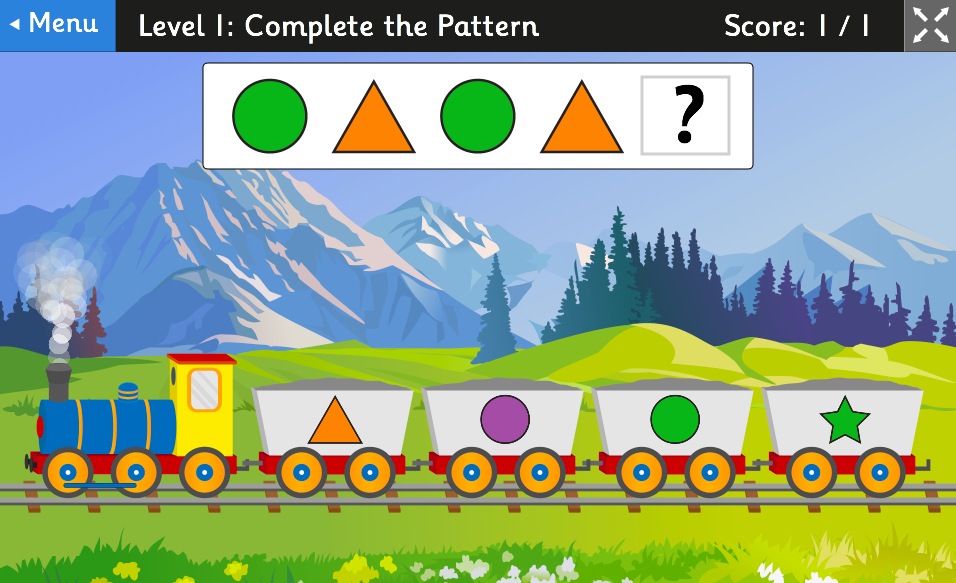
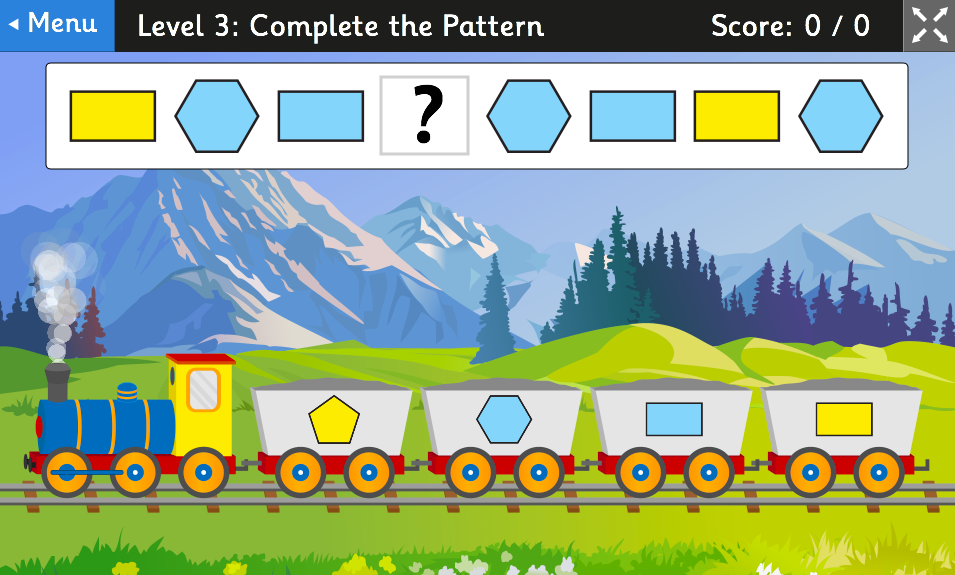
This particular resource is an online game that helps children learn patterning on their computer. Children in the foundation year of school could easily use this when practicing the skill of patterning. All the student has to do is insert the missing shape into the pattern correctly or add what shape would be next in that set.
Children would most likely use a resource ike this when they are at the materials language stage as they have to extend or complete the given patterns using various colours and shapes that they recognise. Unlike other various sources similar to this, the game is not limited to a small number of patterns to complete. If students find this too easy or advanced, they have the ability tomove to a higher or lower level to suit their ability.
Textbook: concept,skill or strategy
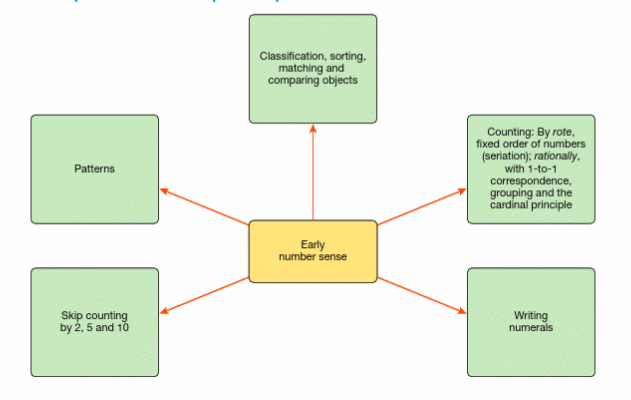
Reys Chapter 7 part 1 discusses the different types of early number situations that young children are exposed to (As shown in the concept map above). Reys desribes early number concepts as the foundation of for building later skills involving numbers. It is important that Early childhood educators help children take advantage of their intuitive mathematical learning. There are different steps that are involved when trying to develop prenumber concepts compared to regular conpets later on that can eventually lead to meaningful counting skills and number sense at a fluent level (Reys, 2014).
References
Education Services Australia. (2016). Monster Choir: making patterns. Retrieved from http://www.scootle.edu.au/ec/viewing/L1056/index.html
Jamieson-Proctor, R. (2019). EDMA241/262 Mathematics Learning and Teaching 1: Week 5 Part 1 (slide 6-24) and Brisbane, Australia: Australian Catholic University.
Reys, R. E. (2014). Helping children learn mathematics 2e. Retrieved from https://ebookcentral-proquest-com.ezproxy1.acu.edu.au
Topmarks. (2019). Shape, Position and Movement, Maths Games. Retrieved from https://www.topmarks.co.uk/maths-games/3-5-years/shape-position-and-movement

 Weekly Reflections