What were the big ideas?
When starting to learn the concept of division students should already have a sound understanding of the previous skills and strategies for the concept of multiplication. This is beacuse just like addition and subtraction, there is an inverse relationship between the two.
The concept of division is to separate any number into equal parts that are smaller. This process of seperation can be shown in two different ways: Partition and Quotition. Partition, which is also frequently referred to as sharing, is when a number is divided into multiple groups to see how many of something each group will get. Quotition however, is also known as repeated subtraction, where a small quantity is repeatedly subtracted from a larger amount in order to find the number of groups needed to divide the total. With multiplication, we know the number of groups and the size of each group. The total is unknown. However, with division we know the total amount, but need to determine either the number of groups or the size of each group (ORIGO Education & DePaul, 2017).
My understanding of the weekly topic has changed. I am now able to clearly see how the previous four operations are all linked together. Because of these new understandings as a teacher in the future, I will make sure that I give my students a good concrete foundation for learning the concepts by modellnig them in different ways before moving onto the next. I will also provide them with the appropriate skills, strategies and terminology to solve these problems, no matter how they are displayed.
Division: One concept, skill or strategy
A popular strategy of division is the Think Multiplication strategy. This is a strategy that requires students to revisit their prior knowledge of multiplication, and use that knowledge to solve division problems because they are inverse operations. Being able to understand this will help students develop a better level of proficiency and fluency equally in both operations.
An example of this strategy is when faced with the problem stating 40 divided by 4, students can use this think multiplication strategy to recall their multiplication facts of 4. Remembering that when 4 is multiplied by 10 it equals 40, therefore 40 is divided by 4 must it equal 10. Understanding this opposite relationship is important to solving these problems.
Misconceptions
A common misconception related to the concept of division is becoming confused when dividing by the number ‘0’. The concept of this number, or ‘nothing’ in our symbolic language can cause a large amount of difficulty for early learners of mathematics. It is well known that dividing by 0 cannot physically be done.For example when students are presented with a problem such as, ‘I have 8 chocolates, but 0 friends, how many chocolates can I give to my 0 friends’. Students may not be able to mentally visualise this or be able to model their ideas in a picture or diagram.
To eliminate this particular misconception I would make sure that the students understand what it means to be displayed with the representation of “0” and how they can easily approach problems similar to this. By working through the multiple language model stages, I will be able to use familiar materials and vocabulary to assist students in developing a concrete understanding of the concept of dividing by ‘0’.
ACARA
Division is first introduced to students in grade 2 for students within Australian Curriculum Assessment and Reporting Authority (ACARA, 2019).
Mathematics/ Year 2/ Number and Algebra/ Number and place value/ ACMNA032
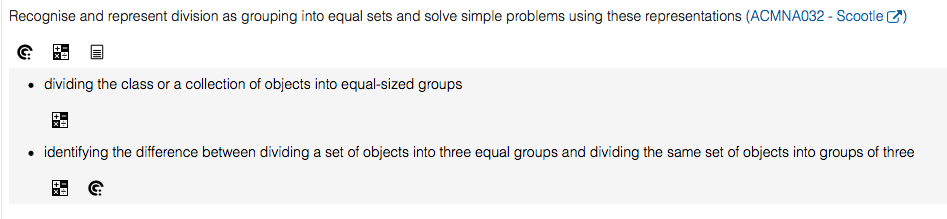
Scootle Resource
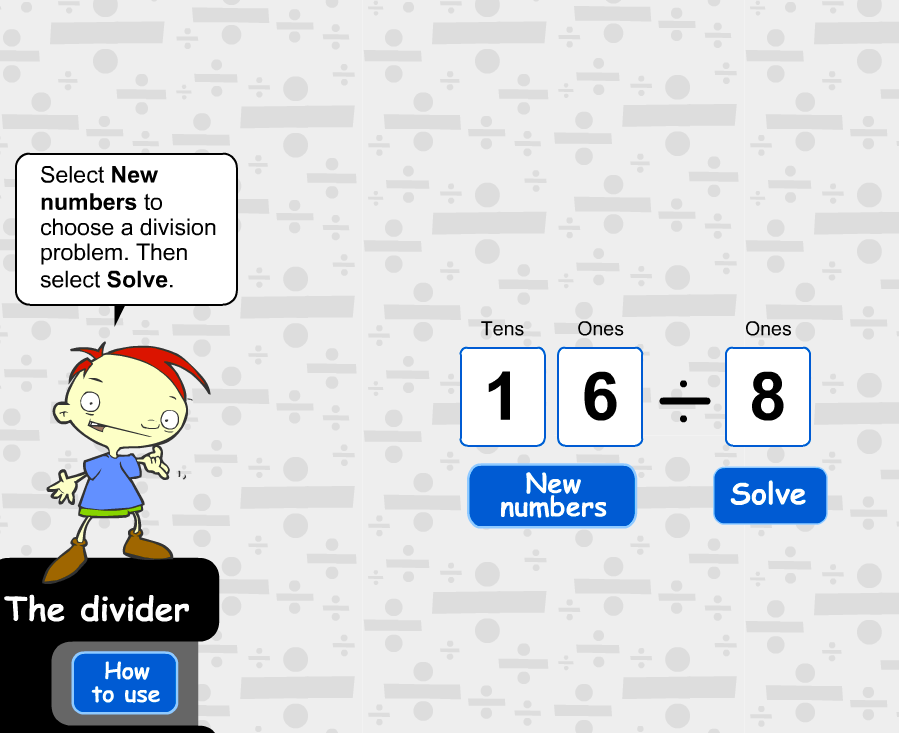
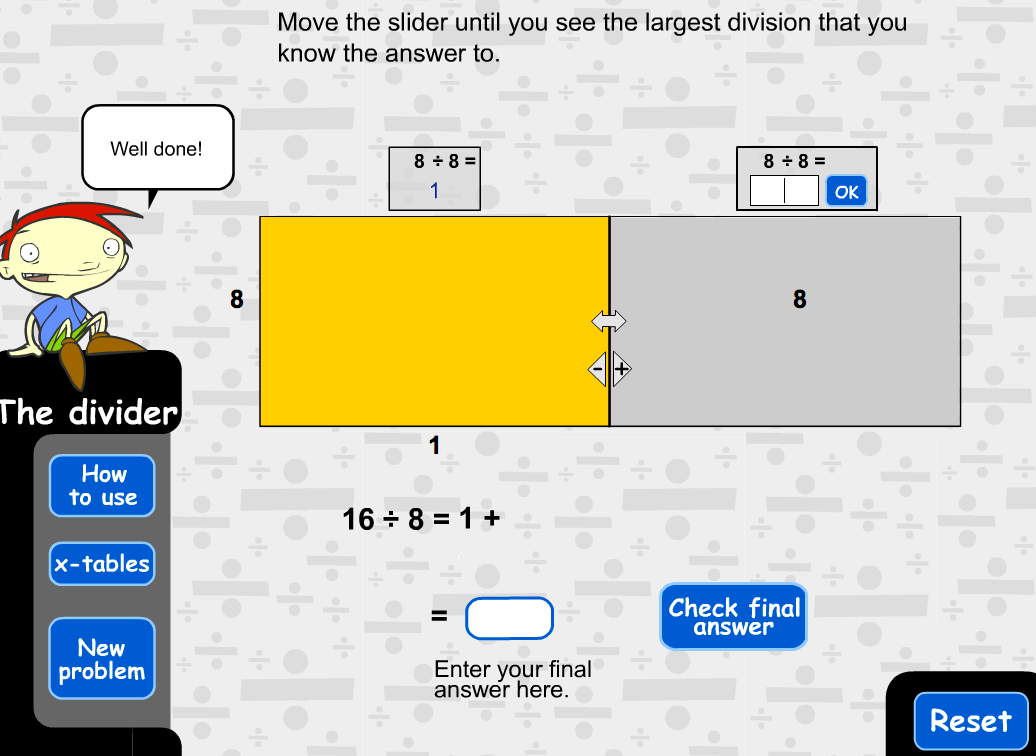
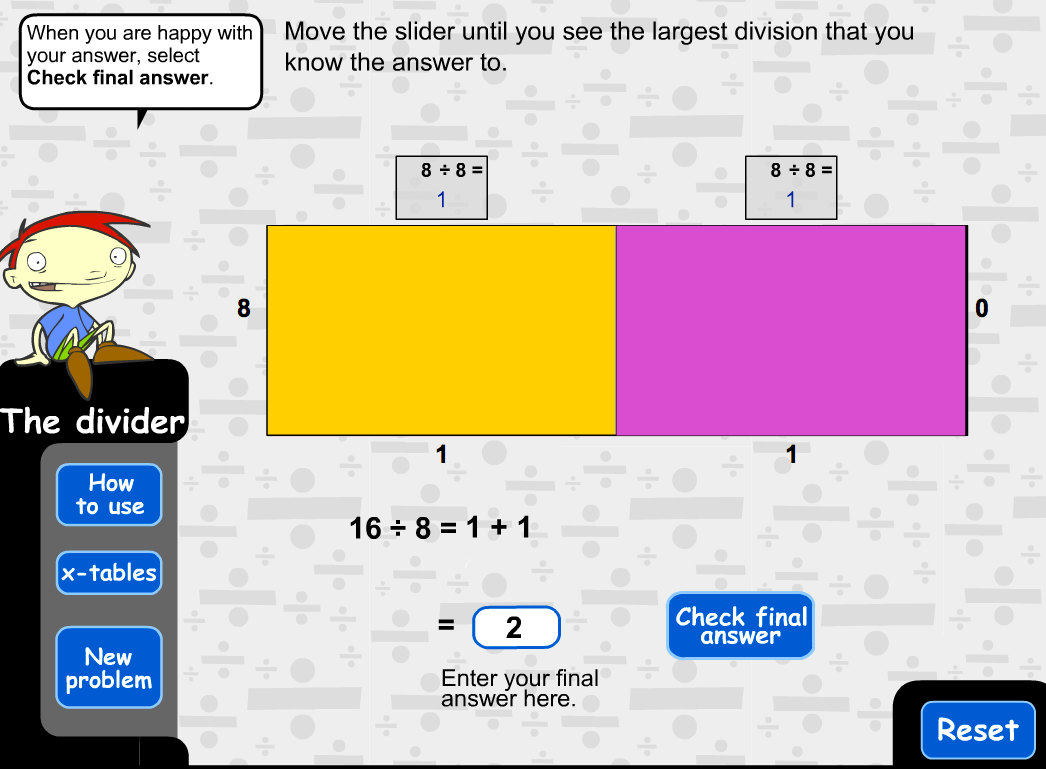
The Divider is a Scootle resource that can be utilised in classrooms for students in year 2, 3 and 4. Students are required to break down larger division problems into smaller, more manageable sized pieces. In this task students are required to solve a division problem by breaking it doen into two halves and only solving it up to the larger part they know. This is demonstrating the Quotition method as the final answer is how many times the smaller number can be taken away from the larger and is not trying to equally distribute any products.
This resource would be appropriate to use at the symbolic language stage of the language model as it purely uses the division symbol to represent what needs to be done in this equation and doesn’t include words such as ‘share’. By breaking down the problems it also allows students to show the fact families and utilise the previously discussed think multiplication strategy.
Resources or Teaching strategies
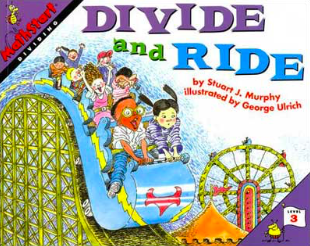
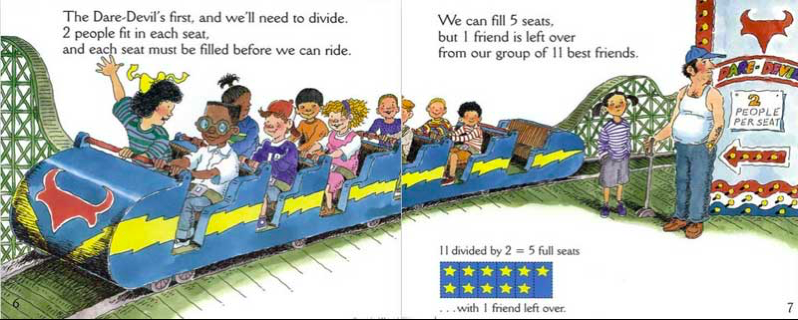
This children’s picture book Divide and Ride by Stuart Murphy and George Ulrich, is a great teachers resource to use when introducing students to the concept of division. The story follows eleven friends at a carnival that have to divide themselves up into different groups to ride the many carnival rides at the themepark (for example: a 2-per-seat roller coaster and a 4-per-cup teacup ride). Just like all of the other MathStart books,at the end there’s a section that includes helpful tips for teaching division lessons (the best children’s books, 2019).
Textbook: concept,skill or strategy
Throughout chapter 11 section 5 Reys relates all mathematical algorithims and strategies back to the use of real world problems and explains why is the best approach for learning about division. Just like the language model Reys agrees that the most important thing is for students to develop an initial understanding of what division is all about is to utilise concrete materials to model division situations just like other operations and to help explain their thinking. A teacher can scaffold students to record their thinking clearly and efficiently on paper. But in order for it to have meaning it needs to be carefully connected to the concrete experience of division (Reys, 2014).
References
Education Services Australia. (2013). The divider: without remainders. Retrieved from http://www.scootle.edu.au/ec/viewing/L2007/index.html
ORIGO Education, & DePaul, D. (2019). Teaching Division Facts: Why the Think-Multiplication Strategy Works. Retrieved from https://www.origoeducation.com/blog/think-multiplication-strategy/
Scootle. (2019). Home. Retrieved from http://www.scootle.edu.au/ec/p/home
The Best Children’s Books. (2019). The Best Children’s Books! — Teachers’ Picks. Retrieved from https://www.the-best-childrens-books.org
Reys, R. E. (2014). Helping children learn mathematics 2e. Retrieved from https://ebookcentral-proquest-com.ezproxy2.acu.edu.au

 Weekly Reflections