What were the big ideas?
When looking at subtraction, students should have a sound understanding of the concepts, skills and strategies for addition, as there is an inverse relationship between the two, and one is a pre-requisite for the other. That is why addition is taught first, before introducing the concept of subtraction (Jamieson-Proctor, 2019).
My understanding of the weekly topic has definitely changed as I myself learnt the importance of the relationship between Subtraction and Addition. I should remember that these are two different things, that correspond to each other.
Therefore, these new understandings will shape my future teaching as I will know the difference between the two concepts, and be mindful of using the correct terminology and language. I will also make sure that my students have a strong understanding of the concept of addition before introducing them to the concept of subtraction.
Subtraction: concept, skill or strategy
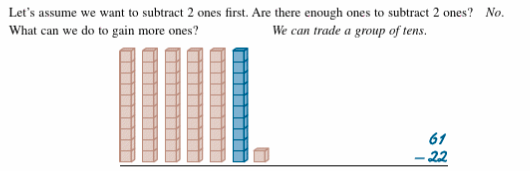
A skill of subtraction concept is decomposition, which is a subtraction algorithm. This is a useful skill as it helps students to subtract one number from another number, by trading larger amounts to break up or “decompose” the parts into smaller more manageable parts. However, in order to be able to grasp this skills students must first understand subtraction concept, as well as place value.
By using physical materials such as MAB blocks, it allows the students to build larger numbers and model essential operations and skills, a place value mat with counters may be an appropriate method also. Students are required to know that they only build the total when subtracting, for example when subtracting 22 from 50, we build 50, as it is that number is total.
Misconceptions
A common misconception many students have about subtraction is that there is only one type of subtraction, and that is ‘take-away’. There are three different types of situations when dealing with subtraction equations. The firstone students are most likely to learn early on in school and the easiest, is called “separation” or most commonly known as taking away. This is where one amount is taken away from another to find out the total that is left. The second is comparison, in which two amounts are compared against each other to find the difference. The third is part-whole, where the amount in the whole set and one part are already known or given, and may be used to find out how many are in the unknown part.
Early instruction relating to subtraction for younger students should provide various opportunities for children to explore these different types of subtraction situations. Children learn the meaning of subtraction through physical concrete experiences in the classroom and then learn to record these equations in different forms. Using manipulatives such as counters or other objects to model subtraction situations is extremely important to develop childrens understandings as well as gain interest.
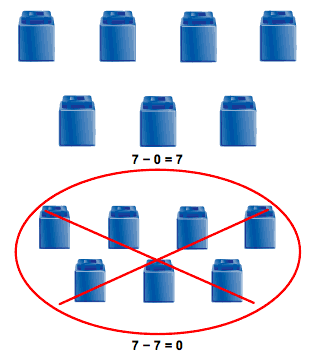
By drawing pictures and using illustrations, children can make the transition to a more symbolic understanding of subtraction. These visual models help children make the connection between the actual items and the numbers and operational symbols used to represent them in a subtraction sentence.
As a students math ability progresses through school, they will continue to use physical manipulatives and pictures to model larger subtraction situations as well as the inverse relationship between addition and subtraction. By drawing these pictures and using illustrations at a younger age, students can make this transition to a more symbolic understanding of subtraction much easier (Houghton Mifflin Math, 2006).
ACARA
Subtraction is first introduced within the Australian Curriculum in Year 1 for students within the Australian Curriculum, Assessment and Reporting Authority (ACARA, 2019).
Mathematics/ Year 1/ Number and Algebra/ Number and place value/ ACMNA015

Scootle Resource
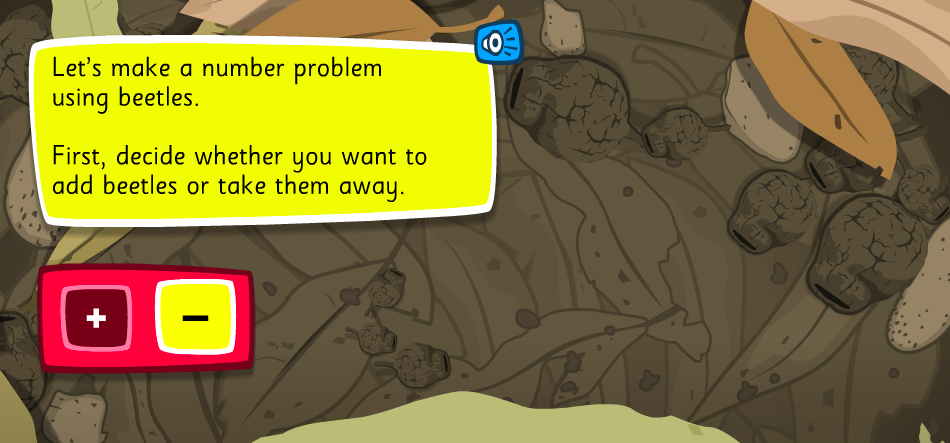
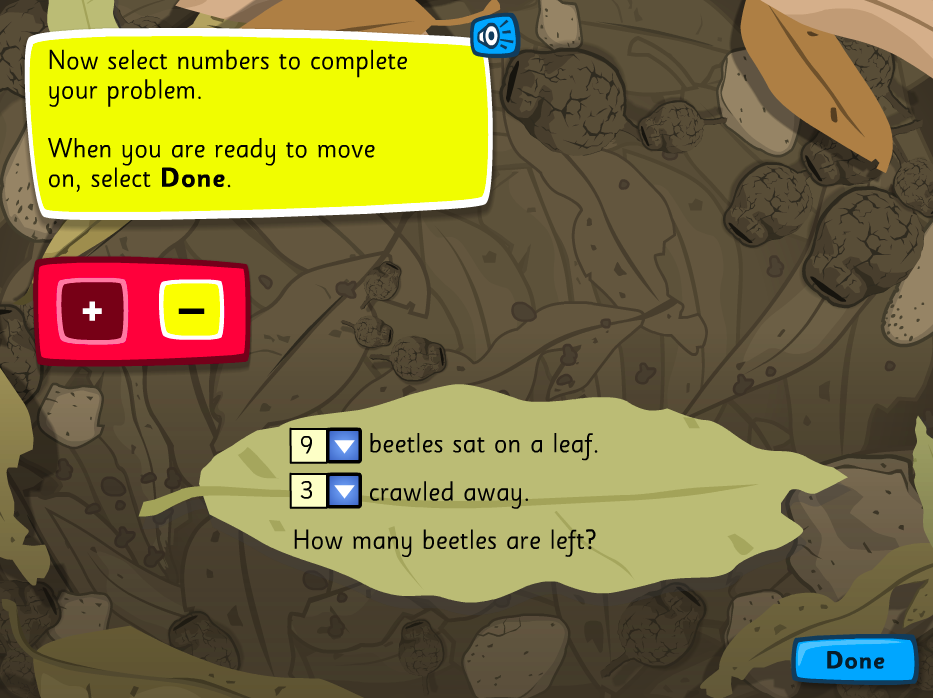
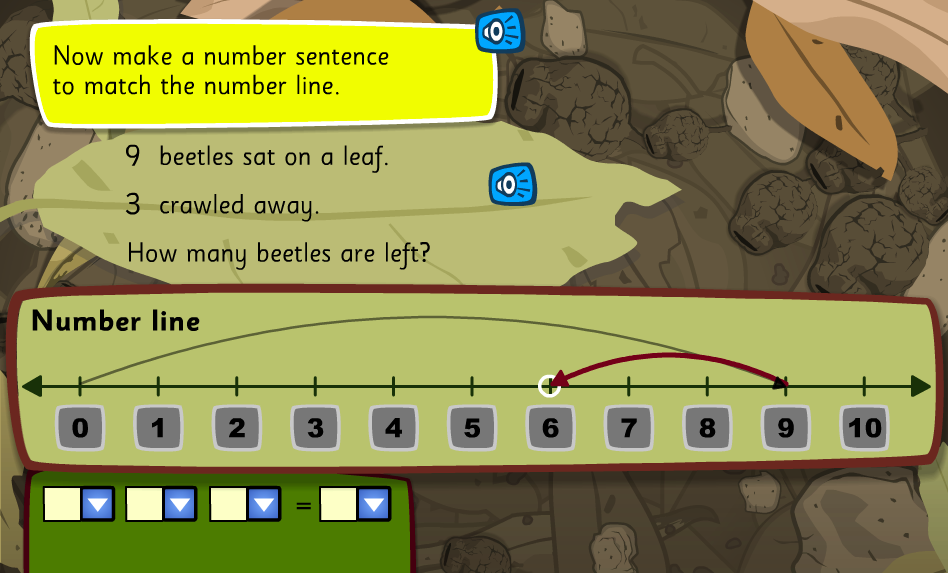
Counting beetles: making word problems is a Scootle resource that can be used for children from the foundation year, grade 1 and grade 2. Students firstly are required to choose whether they would like to add or subtract. They are then required to select the number of beetles for their problem, and are asked to use the number line to show how to solve the problem. Then the students are required to make a number sentence to match the number line. This activity provides opportunities for students to explore and construc,t number lines, and how useful it is to solve addition and subtraction problems. It also promotes the connection between worded problems, number line models and simple equations.
This resource could be used to demonstrate the skill of using a number line to add groups together. It shows the process of counting on when moving up the number line, and allows students to efficiently and effectively obtain an answer. This resource would be appropriate to use at the mathematical language stage, moving towards the symbolic language stage. It uses a combination of graphics, word problems such as ‘ 3 more beetles came’, diagrams such as the number line, and symbolic representations such as ‘5+3=8’. This resource could be more beneficial for students if it asked the students to reverse the order of the worded problem, the number line and the number sentence. This would perhaps allow for further understanding and comprehension of how these representations are all linked.
Resources or Teaching Strategies
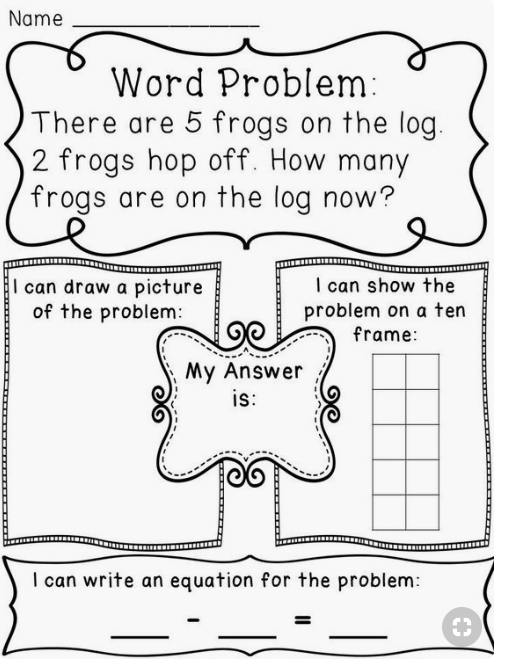
A Strategy Sheet is a resource designed to demonstrate the concept of subtraction. Students are required to read the given word problem at the top of the page and display it using different strategies such as the use of materials, pictures, and a number sentence at the bottom. It shows students the various ways of representing subtraction, in order to gain a more concrete understanding of the concept. This particular resource would be appropriate to use at the very beginning of the symbolic stage of the language model, as students introduced to symbols and number sentences as a way of expressing their ideas. However, this worksheet could be better if the middle was blank so students who have demonstrated a better understanding of the concept could design their own word problems.
Textbook: Concept, skill or strategy
During chapter 11 section 3 Reys explores the standard subtraction algorithm known as decomposition using MAB blocks to form a conceptual understanding of subtraction in a more physical way. This strategy is a very important tool for students to develop the trading and grouping skills that are used when doing subtraction equations. This particular strategy can be first introduced/ is more suitable for students in year 2 within the Australian Curriculum (Number and Algebra: Students solve simple addition and subtraction problems using a range of efficient mental and written strategies ACMNA030). This strategy can be easily altered to demonstrate more difficult problems including hundreds or thousands MAB’s to extend the students skills and knowledge in this operation.
References
ACARA. (2019). Curriculum: Year 1, Mathematics, Number and Algebra, Number and place value (ACMNA015). Retrieved from https://www.australiancurriculum.edu.au/f-10-curriculum/mathematics/?year=11752&strand=Number+and+Algebra&strand=Measurement+and+Geometry&strand=Statistics+and+Probability&capability=ignore&capability=Literacy&capability=Numeracy&capability=Information+and+Communication+Technology+%28ICT%29+Capability&capability=Critical+and+Creative+Thinking&capability=Personal+and+Social+Capability&capability=Ethical+Understanding&capability=Intercultural+Understanding&priority=ignore&priority=Aboriginal+and+Torres+Strait+Islander+Histories+and+Cultures&priority=Asia+and+Australia’s+Engagement+with+Asia&priority=Sustainability&elaborations=true&elaborations=false&scotterms=false&isFirstPageLoad=false
Education Services Australia. (2011). counting beetles. Retrieved from http://www.scootle.edu.au/ec/viewing/L8284/index.html
Houghton Mifflin Math. (2006). Modeling Subtraction: Overview. Retrieved from https://www.eduplace.com/math/mw/background/1/02/te_1_02_overview.html
Jamieson-Proctor, R. (2019). EDMA241/262 Mathematics Learning and Teaching 1: Week 3. Online lecture, Australian Catholic University.
Reys, Robert E.. HELPING CHILDREN LEARN MATHEMATICS 2E, Wiley, 2014. ProQuest Ebook Central, https://ebookcentral-proquest-com.ezproxy2.acu.edu.au/lib/acu/detail.action?docID=4748099.
Teachers Pay Teachers. (2019). Subtraction within 10 Word Problems Worksheets. Retrieved from https://www.teacherspayteachers.com/Product/Subtraction-within-10-Word-Problems-Worksheets-860475

 Weekly Reflections