What were the big ideas?
The main ideas presented in lecture one related to the definition of what mathematics is and how everything could be related back to the conceptual language model for teaching and learning mathematics. This was then followed by a discussion about the negative culture and stereotypes surrounding the subject. As someone who struggled with maths in the past, I found this very interesting because I have always found these concepts very foreign myself during my time in school.
Personal Impact
Being someone who struggled with grasping mathematical concepts in the past, I found this very interesting because I have always found these concepts very foreign myself during my time in school. As an individual seeking to enter the teaching industry in the future, I will make more of an effort to ensure students are not filled with negative thoughts or assumptions about mathematics. Instead, I will aim to demonstrate and explain various practical ways these skills I am teaching them can be applied in their everyday lives outside of the classroom.
Supporting Sources
In their research paper Learning And Fearing Mathematics:
Insights from Psychology And Neuroscience, Booker and Reid refers to these negative connotations surrounding mathematics and goes into further detail about the consequences for these being present in the classroom. Throughout the article, these negative emotions demonstrated by students are labeled as a “barrier to developing mathematical proficiency”. (Buckley and Reid, 2013).
The Language Model Concept
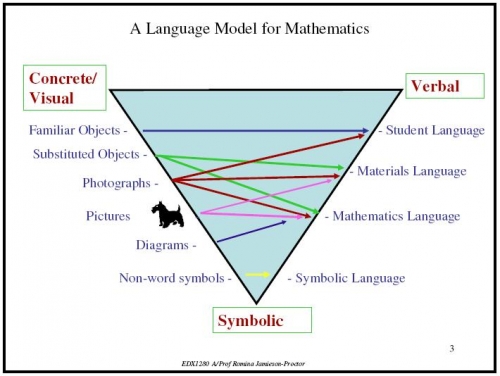
By following the language model for mathematics as a guide, I can assist students in understanding maths in an engaging way. By incorporating activities such as the use of addition mats and MAB blocks. Because the concept of mathematics is first introduced to young students during the foundation year of school I will introduce it to them using visual and hands-on methods, uncomplicated and clear language and the previously listed resources.
After the students demonstrate a solid understanding I will continue to slowly introduce more specific mathematical materials and language such as songs and sums with supportive pictures. Only when the children are completely ready will I consider introducing the abstract mathematical symbols such as plus + minus – and multiply x. By doing this it will also give younger students the ability to relate present day school mathematics to real-life situations around them (Burnett & Wichman, 1997).
The language model diagram below shows the teaching sequence for most mathematical skills taught in the classroom.
Misconceptions
According to ORIGO Education reported by eSchool News, Common misconceptions can cloud a child’s early math judgment so it has become very important to educate teachers on how to avoid teaching them by mistake and how to overcome them. these mistakes in teaching can hinder the learning of basic number concepts and operations that are considered important for developing early math skills. It was often because there are many words (and symbols)with multiple meanings, and students have confused one word or symbol for another with a different meaning (Pierce, 2017).
For Example, the number words “one,” “two,” “four,” and “eight” all have commonly known homonyms: won, to, for, and ate.
Personal Resources
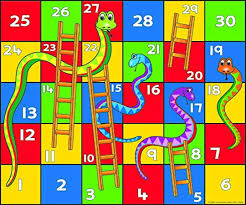
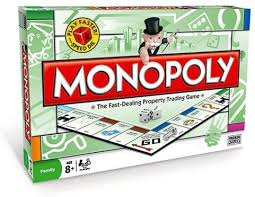
There are already a lot of games on the accessible to the public that claim to assist everyday people in teaching math. For example some that I have at home include Snakes and Ladders which manages to introduce young children to numbers 1 through to 100 in a creative and engaging way. Monopoly is another good one for older age groups for addition, subtraction and introducing the value of money. By using these resources maths can become an activity they looking forward to rather than a repetitve drill.
Digital Tool
I have chosen to display my portfolio of the next 12 weeks on WordPress as it allows me to express myself more visually while being creative with how I want to learn and refer back to content. This was also a bit part of week one’s tutorial. It would be wrong of me to expect my future students to be engaged in a subject that I myself am not enthusiastic about or interested in.
Textbook Source
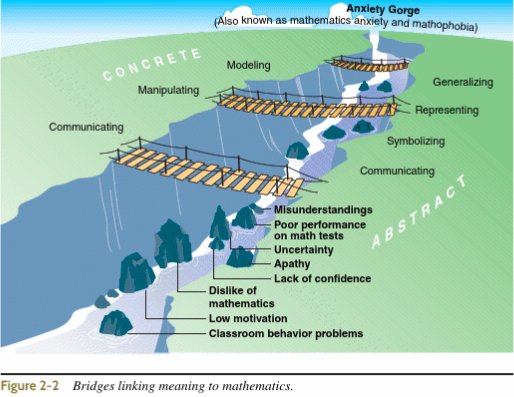
Reys et al., chapter 2, figure 2.2 shows a diagram that demonstrtes an emphasis of meaning and understanding mathematical concepts rather than memorization. Children attempting to or being taught to memorize these concepts or skills without understanding are likely to fall into the “anxiety gorge”. Assissting students to make clearer connections between the concrete (e.g., models and manipulatives) and the abstract (e.g., generalizations and symbolic representations) helps understanding, promotes successful learning, and helps relieve the anxiety that seems to surround mathematics.
Modeling problem-solving strategies rather than presenting student with finished solutions helps them to realise that using incorrect strategies and taking numerous unnecessary steps are a natural part of developing these skills.
References
Buckley S., & Reid K. (2013). Learning And Fearing Mathematics: insights from Psychology And Neuroscience. Retrieved from https://leo.acu.edu.au/pluginfile.php/3070063/mod_resource/content/1/Learning%20and%20fearing%20mathematics.pdf
Burnett, S. and Wichman, A. (1997). Mathematics and literature: An approach to success. Chicago, IL: Saint Xavier University.
Pierce, D. (2017, August 22). The 4 simple misconceptions that can derail early math education. Retrieved from https://www.eschoolnews.com/2017/08/24/misconceptions-early-math-ed/

 Weekly Reflections